Thursday, March 29, 2012

The Last Time I Cried
It was the dawn of March 17th. The hour hand had finally made its tantalizingly slow turn around the clock, and another tiresome week of homework and quizzes had finally given way to another blissful Saturday of rest. Normally, in celebration of the arrival of another day of salvation, I would have slept at around 2 o'clock, about an hour earlier than the average time of my slumber. But that day was no normal Saturday - it was St. Patrick's Day, and so at a little to 3 o'clock, I was laid back in my chair, staring at the ceiling through the pitch darkness and listening over and over to a song that I had been listening to since the clock turned twelve.
During the 18 years of my life, I had listened to a multitude of songs and music. My interests in music had shifted and expanded over the years to encompass a vast range of genres from classic to rock, from folk to hiphop, from country to metal. But never until that day had I ever empathized with the lyrics of a song, so when I heard John Mayer's "St. Patrick's Day," I could not stop listening to the song over and over again.
no way November will see our goodbye
when it comes to December it's obvious why
no one wants to be alone at Christmastime
come January we're frozen inside
making new resolutions a hundred times
February won't you be my Valentine
and we'll both be safe until St. Patrick's Day
From some time, listening to the lyrics, I had started crying. It was not a pouring kind of crying - it has been some time since I have cried with tears flowing down my cheeks in streams. Instead, during the course of the song, a tear would slow grow at the corner of my eyes and at the end of each, it would finally succumb to gravity and gradually creep down my cheeks, down my neck until it reached the neck of my shirt and was absorbed into the fabric. Having listened to the song for hours, I could distinctly feel the moistness of the clothing around my neck.
I sat there, crying and feeling a complex mixture of feelings. I felt sad and depressed; I felt isolated and alone; I felt insecure and incomplete; I felt remorse and regret. The sensation that I had no place to rely on in my times of grief and hardship surrounded me, swallowed me, and overwhelmed me, clawing at my heart and drawing out my tears. The wall on which I could lean on when I was trying to stand up from the blows that life delivered was gone, and the fact that I had put myself in this position, that I had thrown away my happiness and meaning of life tormented and choked me into endless regrets.
Tears entail a variety of meanings. Sometimes it is the result of sorrow and grief, sometimes of contentment, and sometimes of nothing at all. I cried for sorrow. And the truth is, the sorrow still lingers.
Tears entail a variety of meanings. Sometimes it is the result of sorrow and grief, sometimes of contentment, and sometimes of nothing at all. I cried for sorrow. And the truth is, the sorrow still lingers.
Thursday, March 8, 2012
The Comprehensive Range of Who I Am
The heat. The sweat. The frenzy. The thrashing guitar solo and the pulsing rhythm of the drum. And above all, the high-pitched, ear shattering screams of the man who contributed to the musical field of heavy metal. "Sworn to avenge! Condemn to hell! Tempt not the blade, all fear the sentinel!"
A month and a few days ago, I was standing amidst a wild crowd, jumping up and down, slamming into each other, whistling and screaming unintelligible phrases, out of which pretty much only two words could be made out - "Judas Priest." I have been an ardent fan of their heavy metal music, which I often listen to in a multitude of occasions, including during studying, when on the move, and even sometimes in the car or on the bus, while I am sleeping to the rhythmical motion of the vehicle. Thus when I heard that these metal gods were coming to perform in Korea for their final Epitaph world tour, I had seized this precious and last chance and gone to see them in person, albeit from afar.
 At the concert, there was a thirty minute interval between the moment in which the guest performers finished their songs, and the moment when the curtain with the Judas Priest symbol rose up slowly and the legendary figure of Robert Halford emerged on the stage, with his bald head and distinctive beard. During this period of preparation, the crowd could do nothing but wait. While some people started talking to each other about topics both related and unrelated to music - which song from the album "British Steel" they loved best, which solo of KK Downing they had most been awed at, what happened to them on their way to the concert and what they were going to do afterwards, I stood there thinking about how I'd come to see the live performance of one of the still existent defenders of the faith.
 |
| K.K. Downing |
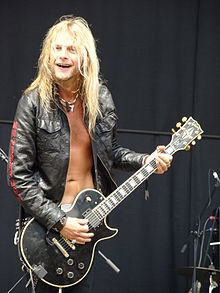 |
| Richie Faulkner |
Come to think of it, my whole personality has always been this way - lenient and comprehensive. I think this is quite evident in two aspects - how I interact with other people and in my academics. In interpersonal relations, I rarely argue my opinion strongly unless it involves dire consequences which I am certain I cannot bear - most of the time, I am tolerant.
I started writing this essay in the dark, not because the lights had been forcibly turned off from the dormitory rooms after two o'clock in the morning to ensure that the students got some decent sleep to support themselves through the following day. No, the time was eleven in the evening, a time when in most other rooms, the main light is turned on, and normal visibility is achieved. Instead the lack of proper visibility was due to the preferences of my roommate who not only prefers the dark, but says that he needs it in order to study. I do not studying in a camera obscura with only a lamplight on, but as he says that he cannot study in other conditions, while I can bear with the dark, I said fine. And it's not the first time. Although I will not disclose particular names, I have had to endure friends watching movies without earphones or headphones while I attempt to do my homework, and I have had to listen to the snores of a roommate who insisted on going to bed before midnight. But I have deemed them as bearable and disregarded the inconveniences they gave me. And I still plan to do so in the future, because I despise the idea that in order to insist on my conveniences, I will be causing another person severe difficulties in whatever it is, academics, slumber, etc.
My comprehensive attitude is also prevalent in my academic preferences, or more decisively, academic dispreferences - none. Zip. Nil. Nada. The range of synonyms is vast, but all in all, it can be said that in every subject I see value and interest. I may not always have talent in all, but I am willing to try out all that I can in order to find that talent, and I am more than happy to do so, as I am interested in all academic subcategories.
This leads me to a life complex and problem that I have been having since about the second grade of my middle school - what to do with my life. I have experimented with a great diversity of subjects since middle school. In middle school, I studied physics for a while, I took the Korean Chemistry Olympiad and got a bronze prize, also received a prize in the Korean Mathematics Olympiad, studied economics with my father, and attempted to read philosophy books (at this, however, I failed). In high school I expanded my interests to art, becoming a member of the school photography club. And the result is that I have no clear idea of what I have to do for a living. People say that the ideal job is that which adequately integrates talent and interest. Well, I think that I am above average in an extensive variety of subjects, but at the same time, do not excel profoundly in one. And I have no particular liking of a subject either, so I have been having the problem that it seems that I ran into a dead end - or rather, a mental quagmire in which everything seems to stick onto me and pull me down. Had just one thing attracted me, then I could have clung onto that vine with passion and saved myself from a lack of hope for the future.
But at the same time, I like to think of this as who I am - a tolerant all-rounder, an intellectual multiplayer. I will live with others as I have done now, putting myself after others. I still have hope that I will be able to find something that fits me perfectly, a job that can employ all my interests and knowledge and will be more gratifying to me than any other career. So still I do not strive to find one specific interest, but keep on living as I have always done, doing everything I can.
As I write, I am listening to the song "Nostradamus" from Judas Priest's album "Nostradamus." "Your future lies within my eyes. What I predict will terrify. I can't control what comes to be, from the past to the present to eternity," sings Halford. If I can't control who I am, then so be it. If who I am will control me, then I leave my fate in my hands. That sounds about right.
On Outliers
I watched Al Gore's renowned documentary "An Inconvenient Truth" in the later part of my 6th grade of elementary school. In fact, I recall that just prior to my entering middle school, my father had called me to his room one weekend afternoon. I remember it clearly. He sat me down on his now discarded chair, a cheap, old product with a seat with flakes that I loved to tear off. He put his headphones on my head, and explaining to me that as I was now going to be a secondary school student, I should acquire knowledge of the substantial problems of the world, turned on the documentary. I remember many aspects of this incident. I vaguely the awe that I felt at the information contained in those 94 minutes. But I recall with the utmost clarity my sunken mood at learning that with the realization of an inconvenient comes the draining of hope.
Yes, I learned that some uncomfortable knowledge lead to despair. With "An Inconvenient Truth" I felt disheartened by the fact that the world was at an environmental crisis, which seemed so disastrous and difficult to resolve. This was equal to the sensation I felt reading "Outliers, the Story of Success" by Malcolm Gladwell, in which he accounts for the causes of success in an unconventional way, focusing not on individual values but on external factors beyond the powers of individuals. I have read up to only the second chapter of his book, but already I feel discouraged.
Actually, I wasn't so depressed with the book until I got to the first chapter - that is, I felt perfectly at ease with the introduction, "The Roseto Mystery." The introduction presented the idea that a person's success has a significant correlation with the environment and situation in which one is placed - definitely not a ground-breaking, mind-shattering revelation. Of course the environment matters. Had a same person been born into two drastically contrasting surroundings - say, one in an affluent and acclaimed family in the suburbs just outside New York, and the other in a family in Somalia with twelve siblings, the outcome of their lives would be just as drastically different.
But my discomfort started from the first chapter, "The Matthew Effect," which introduces the idea that arbitrary cuts of distinction influences one's success. That is, if people, at an early age, are divided into groups, for instance, by date of birth with arbitrary cutoff dates, then there appear differences within that group, not by talent, but by age. The older children who have lived almost a year more than the younger ones are physically and psychologically considerably advanced, as growth is a steep function of time during that age, and this maturity is confused with talent, thus leading them to be classified as gifted. This, in turn, provides them with better education or training, which gives them an additional advantage, and this goes on until the "accumulative advantage" has widened the gap beyond the capacity of recovery by personal efforts. As of the validity of the theory, I was quite convinced. My problem was that the solution was feeble. With every accusation of a problem should come the suggestion of a solution that will help overcome the challenge. Although Gladwell does state multiple cutoff dates, it seems far from realistic, in that this, unlike what he claims, will require much more work and money than now, and that the classification of people into smaller groups is not necessarily a positive thing.
My negative emotions deepened with "The 10,000-Hour Rule." Reading the title and the first few pages I was able to grasp what the chapter was trying to say, and I was glad that the importance of persistence was being explored. I relate to this very personally, as I am well known among my peers to be the madman whose hobby is staying up all night doing his homework and studying for his quiz, the madman who exploit himself so much that every week he loses a few kilograms of weight. But the story did not go as I expected. For one, the book disregarded talent, and also, it emphasized too much the importance of luck. Unlike what the book says, it is because of talent and the interest that the talent provokes that people get the motivation to practice and work 10,000 hours at something. And the reliance and emphasis on the importance of luck is most disconcerting. It is a tendency to leave things up to fate, and to leave one's success to things beyond one's control is too passive a stance. So reading the chapter, I was displeased, and perhaps a little angered.
Find the reasons for success in many places and in many factors. But don't give up, and don't make others give up. That's the problem I found with "Outliers."
Thursday, February 9, 2012
30 Things About Myself
30 Things About Myself
1. I am from Ilsan. I was born in Seoul, and before elementary, school, I have lived in various places including Jeju Island. However, when I entered elementary school, my family moved to Ilsan, and I have lived there until I entered KMLA, except for the time when I was in Canada.
2. During the fourth and fifth grades of my elementary school, I lived in Toronto, Canada for two years in order to enhance my English skills. Unable to speak English well, I had much difficulty at first having to get along with the students in the beginning, but by then end of my stay there, my abilities devloped, and at the graduation ceremony I gave a speech as a representative of the grade.
3. I am currently the editor-in-chief of Minjok Herald. Currently, I am dedicating a lot of time everyday to Minjok Herald, and it is my biggest concern and interest. I am positive that the next edition can come out in late March or early April.
4. I do not have a planned major. I like a multitude of subjects and have no clear favorite. In college, I also wish to keep studying a vast range of subjects in both the humanities and the sciences.
5. For that matter, I do not have a dream career. After enrolling in the academic studies of numerous studies, I want to choose not a career that involves only one field of study but rather a coalition of numerous fields of academics. I am still in thought as to what job yields such opportunities.
6. I suffer from chronic sleep deprivation. This is because when I have work to do, such as homework or quizzes, I stay up until late, and it has become so much of a habit that I feel strange going to bed early. I usually stay up late, and regret it when I have to wake up.
7. I have another busy semester ahead of me due to the courses I am taking - just as busy as last semester. I am taking pretty much the same classes I took last semester. Last semester, there was a time when I had to forfeit my meals and substitute them with ramen, due to papers (AP World History especially) and quizzes (AP Physics C especially). I am not looking forward to it.
8. I like to do nothing, or at least nothing productive. I like to lie in bed and simply think about things, close my eyes and pretend to think about things and fall asleep, or just take my computer and play.
9. In fact, there is one single thing that I want to do in the future - retire. I want to be in a fulfilling job. I want to contribute to my field, my country, and perhaps even the world. I want to do this for a short time but passionately, like a fire, and then retire. I want to live somewhere where I can do nothing and probably watch TV all day long, travel, and do other completely meaningless things.
10. I like to take photographs, or at least did, and plan to do so again. I took photographs diligently in my freshman year, did just about nothing in my junior year, and plan to be about halfway between the activities of my first and second years of high school. Before I went into remission, my photograph style was gothic and depressing.
11. I consider myself very compatible. As a roommate, I think I am tolerant of just about everything, at least I am now. I try to understand the habits of others and accustom myself with them. I rarely demand that others change.
12. When I am given a job, I try my best to meet the expectations of others and more importantly, of me. I try to do my very best, and for this, some of my friends call me a perfectionist. This is the reason when I have much work to do, I stay up until late and sleep at three or four in the morning.
13. I am passive and unenthusiastic in interpersonal relations. I do things that are given to me diligently, but I have a tendency to feel tiresome with trying to find things I have to do. I also do not like dealing with other people. Even on formal issues, I do not like having to ask others for help or give them an inconvenience, so I end up doing things by myself. This part of my personality is one that I wish to change this year.
14. I care a lot about other people's feelings or perception with me. When someone is upset at me, then I cannot do anything. I feel depressed and distracted until I can settle issues with that person and make them not so discontented with me anymore.
15. When I am depressed, I like to watch movies or American drama, and then sleep, or if I am very down, listen to Gloomy Sunday. I am currently watching HIMYM. Gloomy Sunday is a good song.
16. My favorite sports is skiing. Each year, I like to go skiing at least a couple of times, something which is getting harder and harder due to my work at KMLA. The winter holidays before I entered KMLA, I went to Japan with my family on Christmas to ski. The snow was unbelievable.
17. I like a vast range of music, as long as it's good. I listen to ballad to rock to hiphop.
18. On the last day of the winter holidays, I went to Seoul to attend a concert. The Epitaph tour of Judas Priest was more than awesome. Despite his age, Halford seemed in good shape. I almost cried of exuberation when they played the Sentinel.
19. Concerning things such as music or food, I hardly dislike anything. I have no preference.
20. I am an atheist and am proud to be so, although I do not like talking about religion with others. This is because I realize that religion is an extremely sensitive matter to peoplle, and I do not like disputes or confrontations of any type, no matter how small.
21. I am a member of the 15th wave DIA. I am grateful for being a member for multiple reasons, some of which can not be disclosed. I often feel good when I think that I am contributing to the school and making it better.
22. My favorite movie is the Lord of the Rings, but every time I try to read the book, I have been foiled by work and studies. I wish I was watching it now.
23. During the winter holidays, I usually spent my time studying French, AP US History, or writing, whether it be homework for the school or competitions. I really enjoy studying French and have great interest in it, perhaps not as much as a few people, but certainly very much.
24. During the winter holidays, I had a chance to travel and hang out at places I had never been. In fact, I got to go to a city that I had never been in before.
25. I have been to numerous countries abroad. I lived in Canada for two years for English studies, and have traveled to the US, several countries in Europe, China, Japan, and others. Sometime in the next few years, I hope that I can go on a backpacking trip.
26. I have run out of things to say.
Thursday, May 26, 2011
Outline for Highrise Assignment
I want to compare and contrast my life and home with those of Sylva, the photographer who lives in Prague. I want to approach the assignment from the following perspectives.

 To begin with, I want to compare the career of Sylva as a photographer with my hobby of taking photos. In particular, I plan to mention the significance and meaning of photography to Sylva and me. In the video clip about Sylva’s father, who also takes photographs, Sylva’s father states that he had begun taking photos of insects and flowers which attracted him, but that soon the environment, the barren and concrete buildings, began to show themselves in his photos. He and Sylva say that through photography, they learned the meaning of their neighborhood and environment to them. Similarly, I like to take photographs of the environment that surrounds my home as well. I live in Ilsan, and near my home, there is a large park, where I frequently take photos. I think that photography has also taught me the value of the precious environment that surrounds my home.
 Second, I wish to contrast Sylva’s and my perceptions towards the urban area. In the clip about the Prague Castle, Sylva states that the Prague Casle is located 20 kilometers away from her house, ini the city, but that living in the apartment is better than living in the city. In contrast, I share the common perception of Koreans that living in cities is in many ways more beneficial than inhabiting rural areas in terms of proximity to services including hospitals, stores, etc. Therefore, I am grateful for the fact that my current home is located near the center of Ilsan.

 To begin with, I want to compare the career of Sylva as a photographer with my hobby of taking photos. In particular, I plan to mention the significance and meaning of photography to Sylva and me. In the video clip about Sylva’s father, who also takes photographs, Sylva’s father states that he had begun taking photos of insects and flowers which attracted him, but that soon the environment, the barren and concrete buildings, began to show themselves in his photos. He and Sylva say that through photography, they learned the meaning of their neighborhood and environment to them. Similarly, I like to take photographs of the environment that surrounds my home as well. I live in Ilsan, and near my home, there is a large park, where I frequently take photos. I think that photography has also taught me the value of the precious environment that surrounds my home.
 Second, I wish to contrast Sylva’s and my perceptions towards the urban area. In the clip about the Prague Castle, Sylva states that the Prague Casle is located 20 kilometers away from her house, ini the city, but that living in the apartment is better than living in the city. In contrast, I share the common perception of Koreans that living in cities is in many ways more beneficial than inhabiting rural areas in terms of proximity to services including hospitals, stores, etc. Therefore, I am grateful for the fact that my current home is located near the center of Ilsan.
 Third, I plan to compare and contrast the buildings near my home and the building mentioned by Sylva. Sylva talks about the building that is nicknamed the ‘Great Wall of China,’ which she describes using the words ‘morbidly beautiful in its ugliness.’ This is because the structure is a uniform block of concrete. However, the buildings in Korea near where I live don’t seem to be so different either. There exist many skyscrapers that are built from the same materials, concrete and iron, and look alike – the form of a box. However, the difference exists that while the buildings in Prague once held a political meaning as symbols of socialism, as Sylva says, the buildings in Korea hold no such meanings.
Finally, I will write about settling down versus moving around. Sylva states that the most important event in her life happened when she had the twins, which made her settle down in one place. In contrast, I am not confined to one place. Rather, I am prone to moving around a lot, between my home and KMLA, and also to other places because I am at that age when travel is common. Therefore, while Sylva may closely feel the importance of her home greatly, it sometimes rather eludes me, because I am away for many days at times.
Thursday, April 28, 2011
Satire Plans
Satire is primarily a literary genre or form, although in practice it can also be found in the graphic and performing arts. In satire, vices, follies, abuses, and shortcomings are held up to ridicule, ideally with the intent of shaming individuals, and society itself, into improvement.[1] (...) common feature of satire is strong irony or sarcasm—"in satire, irony is militant"[2]—but parody, burlesque, exaggeration, juxtaposition, comparison, analogy, and double entendre are all frequently used in satirical speech and writing. (...)
Satire is nowadays found in many artistic forms of expression, including literature, plays, commentary, and media such as lyrics.
(Wikipedia)
:What I wanted to do was satirize the policies enacted by the government. I searched through the latest government policies.
The Women's Department of Korea has succeeded in altering the shape and design of the traffic lights. Now, instead of just the figure of a man walking or standing, there has been added the figure of a woman wearing a skirt alongside the already existent figure.
I want to satirize the waste of public funds that went into this policy and also satirize the still existent prejudice prevailing in this policy.
I am planning to make a make a sort of poster advertising the policy revealing the fallacy of the policy or on the contary, an opposition by a person who disagrees.
Satire is nowadays found in many artistic forms of expression, including literature, plays, commentary, and media such as lyrics.
(Wikipedia)
:What I wanted to do was satirize the policies enacted by the government. I searched through the latest government policies.
The Women's Department of Korea has succeeded in altering the shape and design of the traffic lights. Now, instead of just the figure of a man walking or standing, there has been added the figure of a woman wearing a skirt alongside the already existent figure.
I want to satirize the waste of public funds that went into this policy and also satirize the still existent prejudice prevailing in this policy.
I am planning to make a make a sort of poster advertising the policy revealing the fallacy of the policy or on the contary, an opposition by a person who disagrees.
Subscribe to:
Posts (Atom)